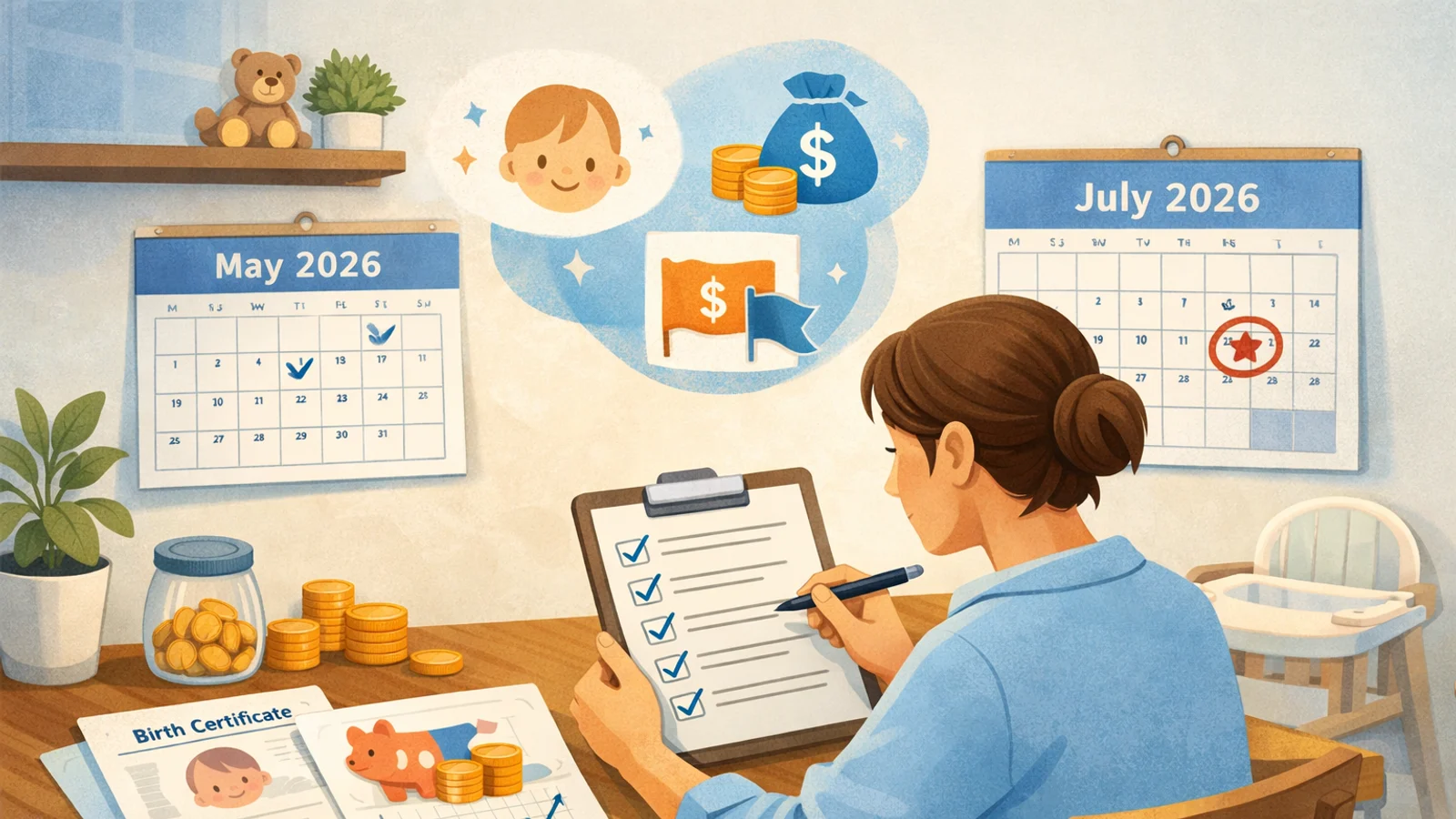
What parents should know right now about 2026 baby savings account changes
If you are hearing about the new federal baby savings account rollout and trying to figure out what actually matters this spring, here is the practical version.
As of March 17, 2026, the big dates parents should watch are:
- Around May 2026: activation information is expected to start going out after an election is made.
- July 4, 2026: contributions are scheduled to begin.
- No earlier than July 4, 2026: the federal $1,000 pilot contribution can be deposited for eligible children once the required election is made and the account is opened. (irs.gov)
For BabyFund readers, the useful question is not just "What is changing?" It is: What should I do before May, before July, and after July 4?
The current parent questions we are seeing most
1) Who is this for?
Current federal guidance says the new accounts are for eligible children, and the one-time $1,000 pilot contribution generally applies to children born between January 1, 2025, and December 31, 2028, if the required election is made and eligibility rules are met. Official IRS and White House materials also describe the account as a new type of IRA for children. (irs.gov)
2) Can I put money in now?
No. Current IRS guidance says contributions cannot be made before July 4, 2026. That means families who want to prepare now should focus on paperwork, eligibility, identity details, and a savings plan rather than trying to fund the account early. (irs.gov)
3) What happens in May 2026?
IRS guidance says that starting in May 2026, Treasury or its agent is expected to send activation information after an election is made, and account opening will require an authentication process. In plain English: there is likely to be an extra step between saying "yes, open this" and having a usable account ready for funding. (irs.gov)
4) How much can families contribute?
Current public guidance says the standard annual contribution cap is $5,000 per child, with future inflation adjustments after 2027. Some employer, charity, or government-related contributions may follow separate rules, so parents should not assume every dollar is treated the same way. (whitehouse.gov)
5) How is the money invested?
Current guidance says these accounts are limited to broad U.S. equity index funds meeting specific legal requirements, including a low fee cap and no leverage. That means parents should expect a narrower investment menu than in a general brokerage account. (whitehouse.gov)
A simple planning timeline for parents
Before May 2026
Use this period to get organized.
- Confirm your child’s legal name, date of birth, and Social Security number records are accurate.
- Decide which adult will handle the election and account setup.
- Save copies of birth and identity documents in one place.
- Set a realistic family contribution target for the second half of 2026.
- If grandparents or other relatives want to help, decide now whether gifts will be monthly, quarterly, or one-time.
This is the stage where BabyFund can be most useful: not as the account provider itself, and not as a government agency, but as the place where families turn a confusing launch into a workable savings routine.
Around May 2026
Watch for activation and authentication steps.
A practical parent checklist:
- Look for official notices tied to the election and activation process.
- Complete any required authentication quickly.
- Keep records of confirmations, screenshots, and dates.
- If you do not receive expected information, be ready to follow up using official channels.
Because the rollout is still being implemented, families should expect some process details to become clearer during spring and early summer 2026. That is an inference based on the recent IRS proposed regulations and rollout notices. (irs.gov)
Starting July 4, 2026
This is the main action date.
From that date, current guidance says:
- regular contributions may begin,
- the annual family contribution framework starts applying, and
- the federal pilot contribution may be deposited for eligible children once the election and opening steps are complete. (irs.gov)
What BabyFund parents should do now
If you want a practical plan, use this one:
- Make a document checklist now.
- Set a July contribution amount now, even if it is small.
- Choose your helpers now — parent, grandparent, or employer.
- Track the May 2026 activation window carefully.
- Start contributions promptly after July 4, 2026 if the account is ready.
Even a modest plan is better than waiting until summer and trying to figure everything out at once.
One important caution
Families should be careful not to assume that every headline or social post captures the actual rules. The most reliable public guidance so far is coming from the IRS, Treasury, and White House materials, and those materials make clear that the rollout depends on elections, account opening steps, and formal timing rules. (irs.gov)
BabyFund should not present this as guaranteed tax, legal, or investment advice. Parents may still want professional advice for family-specific questions, especially around eligibility, employer contributions, or how this fits with other savings goals.
Bottom line
For parents in March 2026, the biggest mistake is thinking there is nothing to do until July.
There is.
Use spring 2026 to prepare documents, watch for activation steps around May 2026, and be ready for contributions starting July 4, 2026. Families who prepare early will have a much easier time once the rollout becomes operational. (irs.gov)